
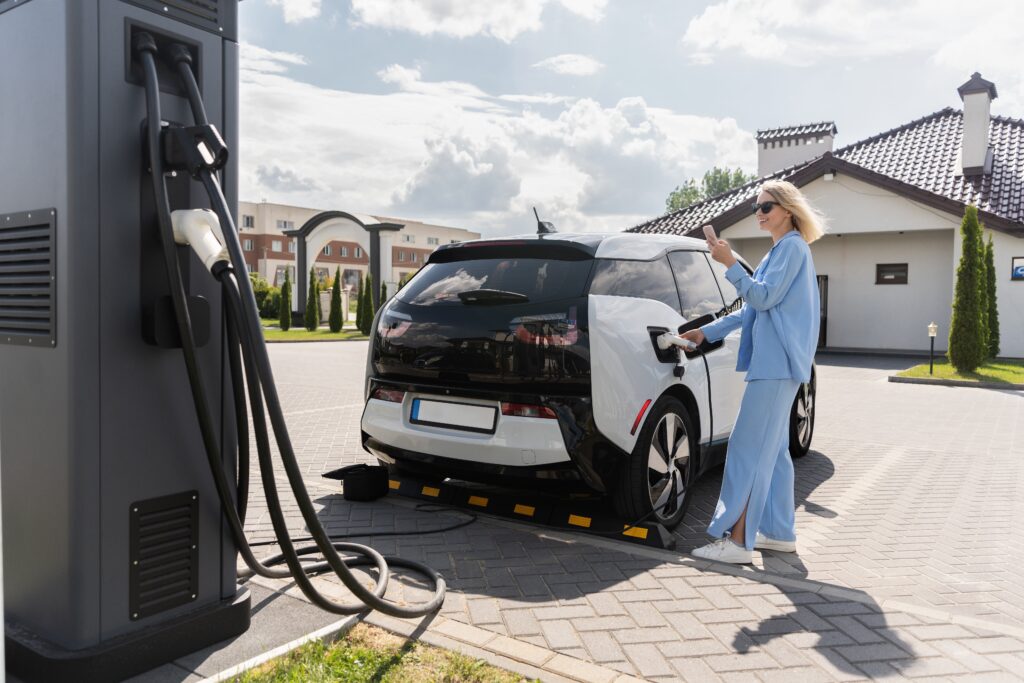
As California works to expand access to electric vehicles for more residents, the 2025 California Green Building Code (CALGreen) increases requirements for multifamily EV charging infrastructure under Section 4.106.4, Electric Vehicle (EV) Charging for New Construction. Building on changes introduced during the July 2024 intervening code cycle, which raised EV-ready parking requirements to 40%, the 2025 code further strengthens these provisions by requiring up to 100% of parking spaces to be EV ready.
Prioritizing Low Power Level 2 Outlets
Single-family homes and townhouses with a dedicated garage are required to have EV CAPABLE spaces, which means providing empty conduit and reserved capacity at the electrical panel for future EV charging. In multifamily housing, however, where parking is typically located in a shared lot or structure, the critical infrastructure requirement shifts to Low Power Level 2 receptacles.
From CALGreen Chapter 2 Definitions, we see this important definition: “LOW POWER LEVEL 2 ELECTRIC VEHICLE (EV) CHARGING RECEPTACLE. [BSC-CG, DSA-SS, HCD] A 208/240-volt 20-ampere minimum branch circuit and a receptacle.”
As a result, designated parking spaces must include one of these receptacles, fully wired and ready for residents to plug in their own charging cord. Ideally, these outlets would be connected to the occupant’s individual electric meter, but the code allows exceptions where this is not feasible. In practice, some developers are addressing cost recovery by installing outlets that require a key or third-party app to operate
How many receptacles are required?
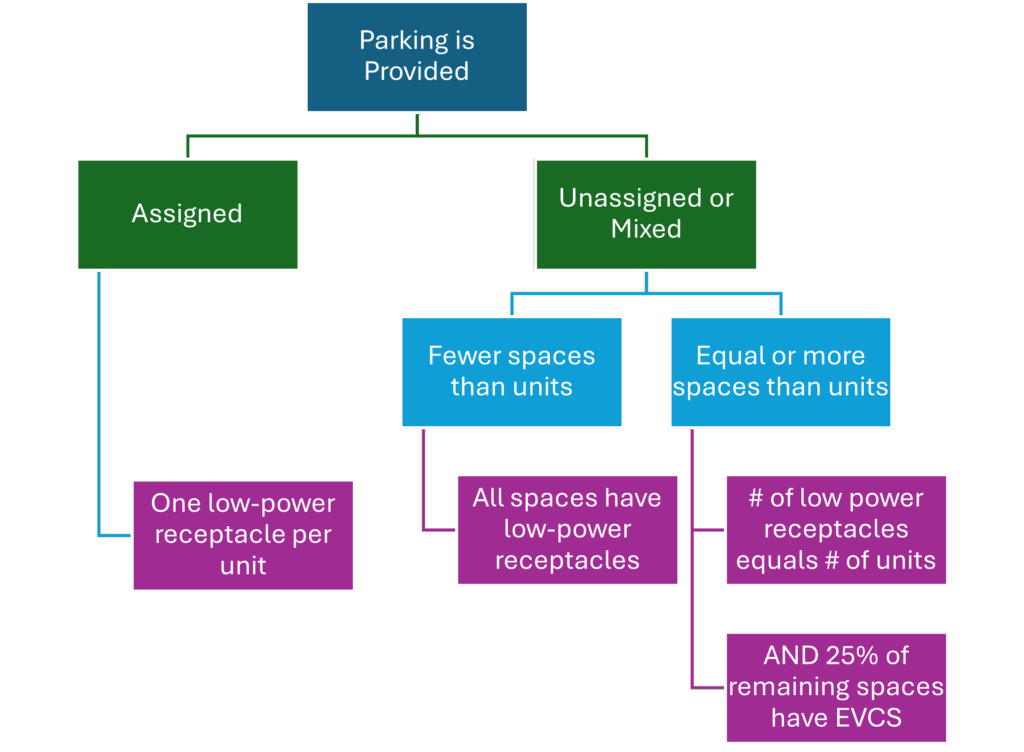
The number of spaces that must be equipped with receptacles depends on both the total number of parking spaces provided and whether those spaces are assigned to individual housing units or designated as unassigned, common parking. The general target is one Low Power Level 2 receptacle per housing unit. However, because many developments do not provide one parking space per unit, the code is structured to maximize EV-ready infrastructure within the available parking. Conversely, when a project includes a large amount of parking, any ‘extra’ spaces designated for common use must go beyond receptacles alone. In these cases, the code requires EV Charging Stations (EVCS), not just a receptacles, for 25% of common parking spaces.
A few examples
- A housing project has 200 units of housing and 140 parking spaces. Since there are fewer spaces than units, it doesn’t matter if the spaces are assigned or unassigned; all 140 spaces must have a 208/240-volt 20 amp receptacle at the parking space. No EV charging stations are required.
- A similar project has 200 units of housing, but 240 parking spaces. 220 spaces are assigned to the units and 20 are left unassigned. In this case, 200 spaces must have the 20 amp receptacle (one per unit) and 5 of the visitor parking spaces (25% of 20) must have actual EV chargers.
- Finally, if the project has 200 units and 240 parking spaces but none of the spaces are assigned, they would still need 200 spaces with 20 amp receptacles but would need to add 10 EV charging stations (25% of the remaining 40 spaces).
Demonstrating Compliance
To make the permitting and inspection process easier, consider the following tips:
- There should be a clear table of parking requirements and calculations on the cover sheet or code analysis sheet, including whether spaces are assigned or unassigned.
- EV Ready receptacles and/or charging equipment should be shown on the architectural site plan (for location and mounting) and the electrical plans.
- Note that parking access compliance (e.g., van accessible) is not required for EV Ready receptacles but is required for charging stations.
- During inspection, make sure the receptacles are live and not just set up “for future EV charging”.
For more information about the 2025 code update and in-person trainings, please check out our events calendar at 3c-ren.org/calendar-of-events-and-trainings
Our on-demand webinars are always available at 3c-ren.org/on-demand-trainings
Don’t wait to reach out to the Code Coach Hotline for more information or to have your Energy Code or CALGreen questions answered! 3c-ren.org/energy-code-coach