
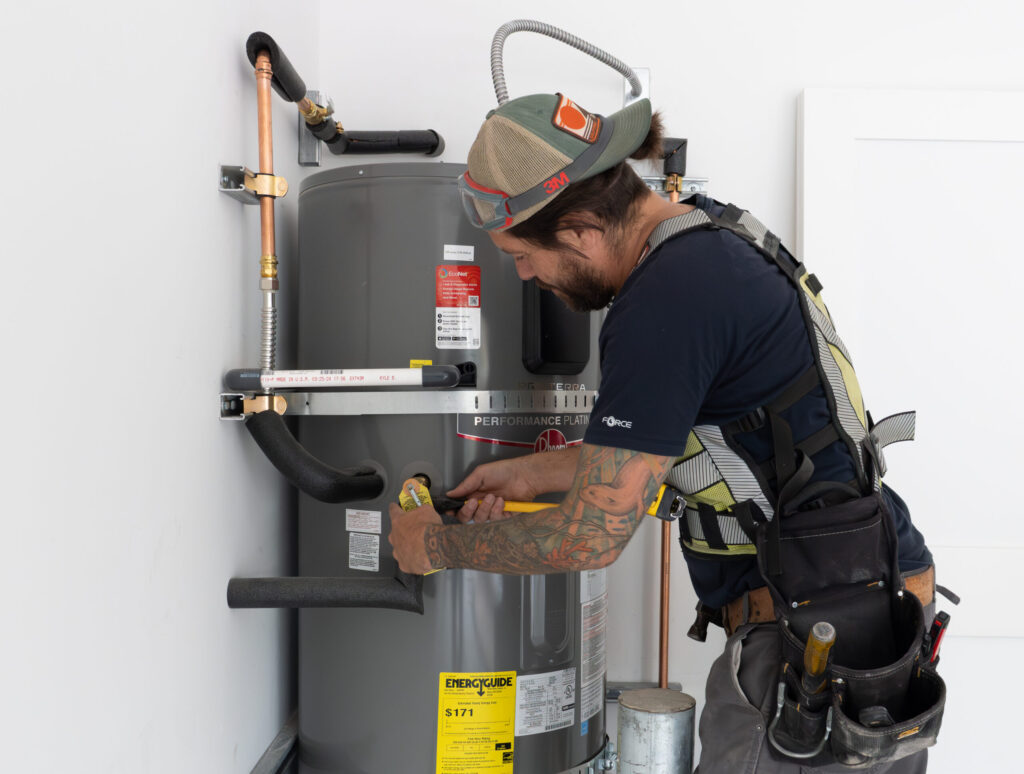
Installation requirements for heat pump water heaters (HPWHs) remain a hot topic, and the 2025 code provides important clarifications and updates in this area. These changes represent a meaningful improvement, emphasizing the importance of proper installation while clearly outlining what the code requires. These updated provisions are located in Section 110.3, Mandatory Requirements for Service Water-Heating (applicable to all occupancies), and Section 150.0(n), Single-Family Residential Buildings Mandatory Features for Water Heating Systems.
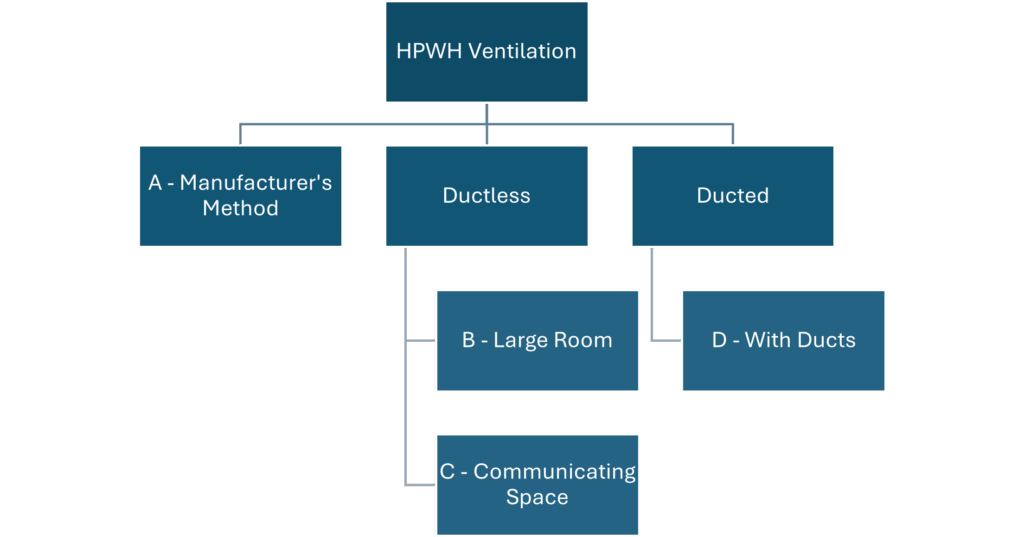
Four Options to Meet Ventilation Requirements
Since HPWHs remove heat from surrounding air, they need sufficient airflow and space to operate properly. To meet the needs of different installation locations, there are four options to meet ventilation requirements.
Option A – Manufacturer’s Approved Method
- If the HPWH is installed exactly as the manufacturer specifies, and the method meets or exceeds the ventilation requirements in code (Section 110.3(c)7B2–B4), then it is considered compliant.
Option B – Without Ducts “Space Volume Method”
- If no ducts are used, the installation space must be large enough to provide sufficient airflow, such as a garage.
- Required volume is equal to at least 100 cubic feet per kBtu/hr of compressor capacity, OR the manufacturer’s minimum volume (whichever is larger).
- Example: A 5 kBtu/hr unit would require 500 cubic feet of space.
Option C – Without Ducts – “Communicating Space Method”
- If the installation space is too small, it may be ventilated into a communicating space (an adjacent room).
- The communicating space must provide the remaining required volume (total minus the HPWH room volume).
- Ventilation must be provided through permanent openings:
- Must be louvered grilles or doors.
- Minimum Net Free Area (NFA) must be:
- 125 sq in + 25 sq in per kBtu/hr of capacity, OR
- The manufacturer’s minimum (if larger).
- Openings must be in the top and bottom halves of the enclosure (upper vent ≤12″ from the top, lower vent ≤12″ from the bottom).
Option D – With Ducts
- If ducts are used to bring in or to exhaust air:
- The space connected by the ducts must meet the same minimum volume requirement as above (adjusted for the installation space volume).
- All duct joints and penetrations through walls must be sealed.
- Exhaust ducts and any ducts crossing pressure boundaries must be insulated to at least R-6.
- If only the inlet or outlet is ducted:
- The installation space must still have permanent openings (grilles/door undercut).
- Ducted inlet: minimum NFA is equal to the duct’s cross-sectional area.
- Ducted exhaust: minimum NFA is equal to the larger of 20 sq in or the manufacturer’s minimum.
- If both inlet and outlet ducts end within the same pressure boundary, airflow must be arranged so that the two air streams are diverted away from each other.
Additional Notes
Here are few additional notes to consider in HPWH installations:
- When multiple HPWHs are installed in the same space, the required volume and ventilation openings must be summed across all units.
- Compressor capacity is calculated using AHRI 540 “High” rating conditions (a standardized test reference).
- Per Section 110.3, Mandatory Requirements for Service Water-Heating, HPWHs need backup heating in certain conditions.
- This applies when the air entering the unit is unconditioned (e.g., outdoor air or unheated spaces).
- Exception: if the HPWH’s compressor is rated to operate at very low temperatures — specifically, below the local “Heating Winter Median of Extremes” temperature (a standard in California’s energy code, Table 2-3 of JA2) — then backup heat is not required.
For more information about the 2025 code update and in-person trainings, please check out our events calendar at 3c-ren.org/calednar-of-events-and-trainings
Our on-demand webinars are always available at 3c-ren.org/on-demand-trainings
Don’t wait to reach out to the Code Coach Hotline for more information or to have your Energy Code or CALGreen questions answered! 3c-ren.org/energy-code-coach